Long before I had language for it, this was one of my first real lessons in what I now call The Perceptive Advantage™ – the human capability to notice what others miss, adjust how we communicate, and create the conditions where truth can actually emerge.
At the time, it was just another day at the police station. I was only about 6 months out of the training Academy and had so much to learn.
Two senior constables were working a drug case and wanted to speak to a woman they believed might have useful information.
“Want to come down to St Kilda with us?” one of them asked. “We’re looking for one of the ‘working girls’ down there. She might know something. You’ll get to see how a difficult interview is really done.”
“Sure,” I said. I was curious and eager to learn anything I could about interviewing uncooperative sources.
“You just watch and learn,” he added. “We’ll handle it. She hates cops. It won’t be pretty.”
Excited, and admittedly a little nervous, I jumped into the patrol car and we headed off to find Krystal.
She was exactly where they expected her to be, on the street corner that she worked from. And she was exactly as hostile as they’d predicted.
“What the f*** do you want?” She glared at my colleague.
It wasn’t a warm reception. There were a few more colourful words for emphasis.
After some sharp exchanges, Krystal reluctantly got into the back of the car. When she saw me, she snapped, “What are you looking at, bitch?”
Back at the station, we escorted her into a large upstairs interview room. As instructed, I sat quietly in the corner and observed.
That’s when the good cop / bad cop routine began.
You know the one. One officer plays calm and sympathetic, the other aggressive and intimidating. The theory is simple: apply pressure, then offer relief. Hurt and rescue. It’s a technique I’d only seen in movies, they certainly didn’t teach it at the Police Academy. I’d always wondered how effective it really was.
Good cop started first. Calm voice. Water in a plastic cup. Encouraging her to “do the right thing.”
Krystal wasn’t buying it.
“F*** off, pig.”
Then bad cop took his turn.
He stood, slammed his hand on the table, leaned into her space and launched into a tirade of threats and insults.
I felt a surge of adrenaline. Part of me was frozen. Part of me was deeply uncomfortable. And part of me was intensely curious. Would this work?
It didn’t.
They persisted, rotating roles.
Krystal stayed closed. Arms folded. Jaw clenched. Contempt written all over her face.
From my seat in the corner, something else was happening. While they were focused on doing, I shifted into awareness. I started paying attention – not just to Krystal’s behaviour, but to what wasn’t working. I quietly browsed her file.
That’s when I noticed something small, easy to overlook, and completely irrelevant to the case.
Or so it seemed.
After nearly an hour, the officers gave up.
“We’re not getting anything from her,” one of them said. “We’ll take her back.”
I hesitated, then asked if I could speak with her.
They looked at me like I was mad. (Remember I was the fresh faced ‘rookie’)
“Why? She didn’t tell us anything. Why would she talk to you?”
I wasn’t confident she would. I was intimidated by her. I felt out of my depth. But my curiosity, and my gut, wouldn’t let it go.
“There’s no downside,” I said. “She’s not giving you anything anyway.”
They shrugged. “Go on then.”
My heart was racing as I pulled a chair up beside Krystal. She turned her body away from me, arms crossed tightly.
“And what the f*** do you want?” she said loudly, making sure the others could hear.
I sat down and lowered my voice to almost a whisper – slow, calm, deliberate. The shift in pace alone changed the energy in the room.
“I don’t want anything,” I said. “I’ve just been sitting over there watching, and while that was happening, I noticed something in your file that I thought was really interesting.”
She stared at me.
Suspicious. Alert. But curious.
“Yeah?” she said eventually. “Like what?”
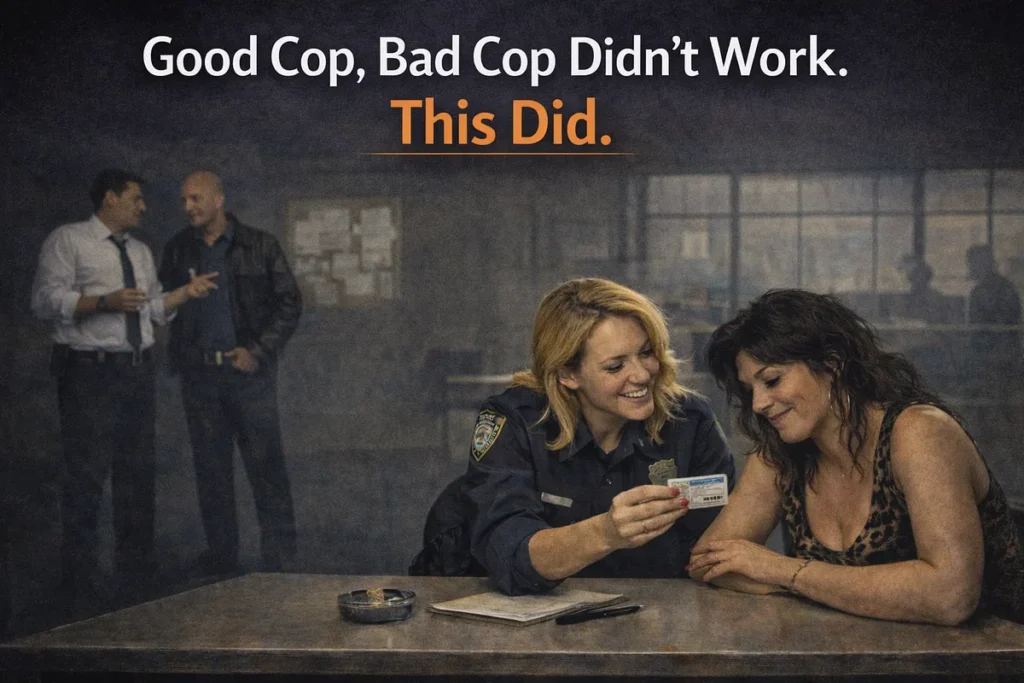
“You know, you and I have exactly the same date of birth?”
“Bull s***.”
“It’s true. We’re both 22. Both born on the 13th of May. Same year.”
Her head tilted slightly.
“Prove it.”
I handed her my driver’s licence. She looked down at it, then back up at me. Her face softened.
“That’s f***ing crazy, sister.”
I wasn’t trying to be clever. I wasn’t using a tactic. I was genuinely fascinated by the coincidence and wanted to share it.
And something profound happened.
Her arms uncrossed. Her posture shifted. Her voice changed. The tension drained from her face.
I leaned in slightly and said, “Isn’t it weird how life works? Same day we came into the world – and here we are at 22. You;re getting hassled by these guys, and me sitting here in this uncomfortable blue uniform skirt trying to save the world.”
She laughed. We talked. About where we were born. About how neither of us knew what time of day we arrived into the world.
For a few minutes, we weren’t cop and offender. We were two young women, sharing a moment of genuine connection.
This is the part people often miss.
When threat drops, perception opens.
Krystal’s body language told the story long before her words did. These weren’t subtle shifts – but they were easy to miss if you weren’t looking for them.
My colleagues were nearby, deep in their own conversation, locked into problem-solving mode. They didn’t see what I was seeing.
Eventually, my professional responsibilities kicked back in.
“Do you actually have the information they’ve been asking you for?” I asked.
She smiled. “Yeah.”
“Would you give it to me?”
Another smile. “Yeah.”
She picked up the pen and started writing. She even gave some additional information.
When I handed the paper to my colleagues, I’ll admit – part of me felt quietly pleased with myself. But that wasn’t the lasting lesson.
What stayed with me was this:
The information didn’t come because I asked better questions.
It came because the conditions for truth had shifted from threat to safety.
Two Perceptive Advantage Lessons
1. Awareness gives you options.
While others were stuck in a script, noticing what wasn’t working – and what others overlooked – created a new and better pathway forward.
2. Connection changes access to truth.
Common ground doesn’t manipulate. It humanises. And humans share more when they feel safe.
I was never a fan of the bad cop approach. Force narrows perception. Threat shuts people down. There are far more effective ways to elicit truthful, useful information.
The Perceptive Advantage™ isn’t about saying the perfect thing. It’s about seeing clearly, communicating differently, and acting at the right moment.
That lesson has stayed with me ever since.