Most people don’t trust instantaneously when they first meet someone.
Trust is built incrementally. We take in vast amounts of information – consciously and unconsciously – and quietly assess what it all means. We scan how someone looks, how they speak, the tone of their voice, the pace of their words, their body language, their facial expressions, what they wear, the consistency of their messages, the substance behind their promises, the setting we’re in, even things as subtle as scent and proximity. Research in social neuroscience shows that these assessments happen within milliseconds, long before logic has caught up.
When trust locks in and we feel safe with someone, that feeling can last.
Until it doesn’t.
Sometimes trust breaks in an instant. More often, it erodes slowly – chipped away through small inconsistencies, missed signals, and moments that don’t quite sit right.
When you trace back situations where ‘sh*t as hit the fan’, you’ll discover they didn’t go from zero to 10 in an instant. Rather they start at a rumble…a vibration that something isn’t right. People are on alert and behaviours start to modify. If nothing is done, the true red flags start to appear. People are hurting, unhappy or fearful. Again, if nothing is done (or done badly) that’s when the rupture happens. People break, relationships break, trust breaks.
Let me share a story I saw unfold..
Many parts of an organisation, let’s call it Company ABC, had been through repeated restructures over several years. For many employees, the change felt constant. Good people were forced into lesser roles, redundancy, or choices that didn’t feel like choices at all. Teams that had never worked together were suddenly expected to operate as one, with little clarity about why the structure existed or how it was meant to succeed.
One of these newly formed groups, let’s call them the Blue Team, sat under a new division with a new direction. They were then introduced to a new leader, who seemed to suddenly appear.
This leader made a point of acknowledging the disruption the team had endured. She seemed empathetic and spoke openly about rebuilding trust, restoring stability, and creating a connected and harmonious working group. She promised transparency, communication, continuity and clarity. For a team that had been repeatedly unsettled, this mattered.
Trust began to form. Slowly. Carefully.
For the first month or so, the leader’s actions appeared to match her words. Team members allowed themselves to believe that perhaps the dust was finally settling. ‘Ahhhh….stability.’
Then things began to unravel.
Priorities shifted without explanation. Commitments quietly changed. Messages became less clear. What had been positioned as stable suddenly felt uncertain. When questions were raised, answers felt vague or deflected. The disconnect between what had been promised and what was unfolding was never directly acknowledged.
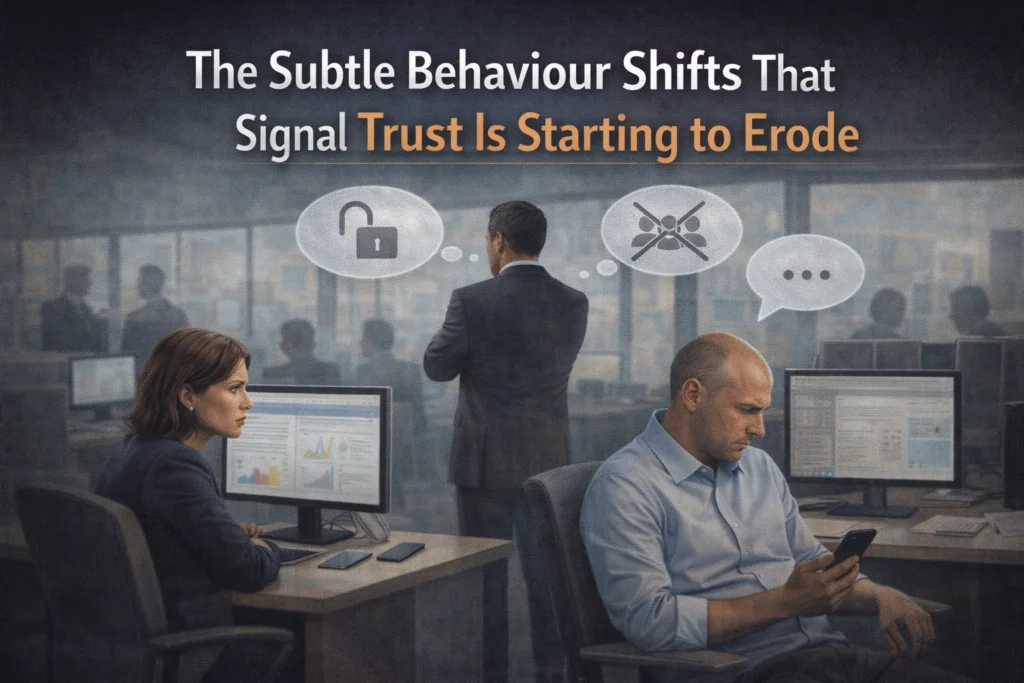
The earliest rumbles of trust erosion showed up in changed behaviours by team members, particularly in meetings.
At first, the more vocal team members asked questions. They sought clarity. They tried to understand what was required and how decisions were being made. Over time, those same people became quieter. Not because they had the answers, but because they were tired of asking.
Other shifts followed.
People stopped offering ideas.
Curiosity gave way to compliance.
Energy dropped.
Body language closed.
Side conversations increased after meetings rather than during them.
These are not engagement issues. They are trust signals.
As time went on, the rumbles became red flags.
Sick days increased.
Cameras stayed off in virtual meetings.
Frustration became visible when questions were met with vague responses.
Behind the scenes, sometimes while meetings were still underway, team members messaged one another about the disconnect between what was being said and what was actually happening.
When trust erodes, people don’t become dishonest – they become cautious about where, when, and with whom they can speak truth.
The rupture came about five months into the team’s formation. The leader suddenly announced that recruitment was commencing for her role, as her ‘contract’ would end in a few months.
Contract? Blue team members were stunned.
The leader had spoken repeatedly about stability, longevity, and commitment. When the shock surfaced, the team was made to feel they had misunderstood – that this had “always been the plan.” At no point had it been communicated that her role was temporary.
The misleading nature of what had occurred was never owned or addressed.
One team member said ‘They are gaslighting us, they’re telling us that our reality is wrong”
This story isn’t just about one leader or one team. It’s about the behaviours and patterns that quietly rupture teams and destroy culture. In this story there were multiple moments of opportunity to handle this transition with truth, honesty and care. If that manager was only ever going to be a temporary appointment, the team would have accepted the truth far more readily than the feeling of misleading that followed.
Throughout this time the team experienced emotions ranging from anger to disappointment, to sadness, and a deep sense of betrayal. Not because change occurred, but because trust was eroded along the way. Over the next few months, several good employees left and others kept a close eye on SEEK.com.
Trust doesn’t usually disappear loudly. It withdraws first. There are always signs.
It doesn’t have to go this way. Perceptive leaders notice the quiet shifts at the rumble stage – the pauses, the withdrawal, the reduction in questions, the change in tone. They understand that trust is built and broken in patterns and if they act early, honesty can still repair rather than rupture.
And of course, if you ever want to quickly break trust, dishonesty is your guaranteed fast track to that outcome!
Once trust reaches breaking point, the work is no longer about building a team, it’s about recovering from damage that didn’t need to happen.