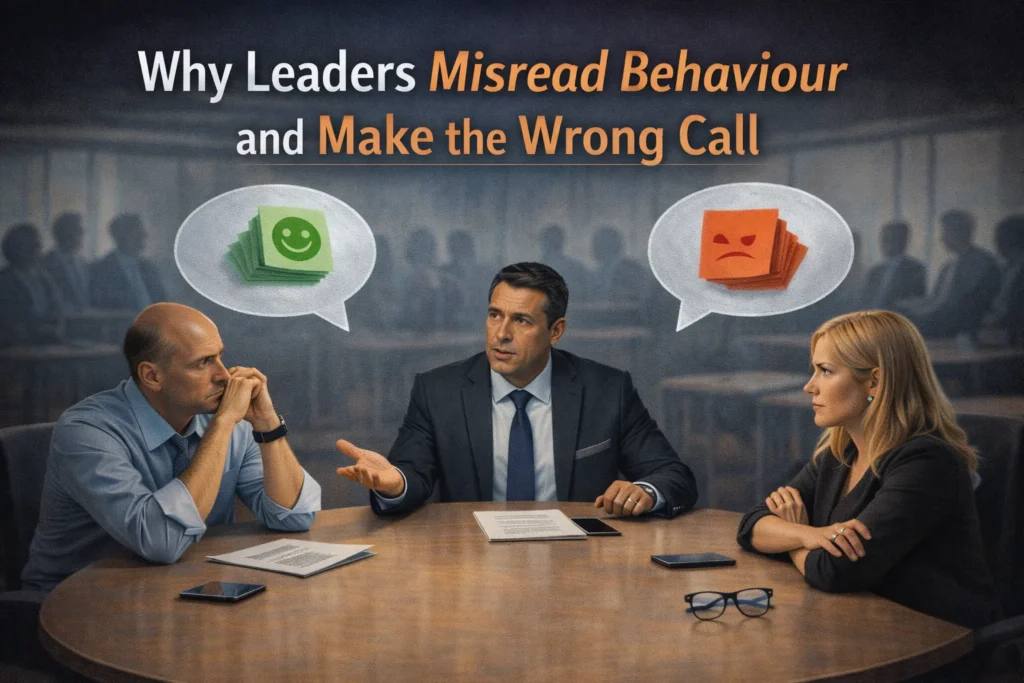
Human beings are wired to read behaviour. It happens automatically, often without conscious thought. Our built in survival mechanisms were designed to scan for threat, safety and intent.
That ability hasn’t changed. What has changed is the environment we’re trying to use it in. Modern workplaces are noisy and busy. Leaders are under pressure, attention is fragmented and decisions are made quickly – often with interruptions and incomplete information. Our behaviour reading mechanisms are still operating, but not always accurately.
This is where things can go wrong.
Anika was leading a capable, high-performing team. She valued momentum, clarity and accountability and she trusted her instincts. When something felt ‘off’, she usually acted.
Over a few weeks, she noticed one of her team members, Marco, becoming quieter in meetings. He spoke less, avoided eye contact, and missed details that usually wouldn’t slip. His energy felt different.
Anika has seen this before in a team member at her last job. She felt sure she knew what it was. Marco was disengaged and had lost motivation. Maybe he was even becoming a bit complacent.
Under pressure to keep the project moving, she made a call. She pulled Mark aside and delivered him firm feedback about expectations and commitment. Certain that he needed more structure and clarity about what had to get done, she reduced his autonomy and set more frequent check-ins on his progress.
What Anika didn’t see, or didn’t pause long enough to explore, was what was actually driving Marco’s behaviour. He was carrying work across multiple projects, something he usually managed well. Outside of work, however, the weight was far heavier. He was in the middle of an emotional break up plus was navigating a challenging situation with his brother, who was bipolar and had recently taken himself off his medication.
Marco’s behaviour wasn’t resistance or withdrawal, it was overload. The conversation and added pressure from Anika didn’t improve performance, it compounded the problem.
Misinterpreting someone’s behaviour and not taking steps to check your belief can lead to disconnection, disengagement and resentment.
So why do we get it so wrong?
We like to think we are good at reading people and most of us are confident in our interpretations. Research, and experience, suggests otherwise. People consistently overestimate how much we notice and how accurate our conclusions are.
Our brains are meaning-making machines, they don’t like ambiguity. When behaviour is unclear, our brains rush to explanation, drawing on past experience, bias, belief and whatever story feels most familiar or convenient.
I’ve seen this play out hundreds of times in my workshops. I’ll show a short video and give a very clear instruction: just observe. ‘Tell me the raw data’ – the behaviour you see or hear. No interpretation. No judgement. Don’t make it mean anything.
And guess what happens? Every single time, more than 80% of the room jumps straight into telling me what the behaviour means. They draw confident conclusions about what’s going on. Some even starting the sentence with ‘Well, it’s obvious that….’
It doesn’t matter how many times I instruct, ‘Don’t interpret yet’. The brain simply can’t help itself.
This isn’t a personal failing, it’s human cognition doing what it was designed to do. The problem is that in leadership, sales and business, the speed of interpretation often outruns accuracy.
Many things can quite distort how behaviour gets interpreted. Mood plays a role. So does what happened just before the interaction. Think about how differently you might read a text message depending on the state you’re in at the time.
When instinct gets treated as certainty, people can jump from sensing to deciding. We like to make assumptions. We mind-read. We label. Action follows and the wrong calls can be made.
This is why my work doesn’t stop at awareness. I show people how to expand their perceptive awareness so they genuinely see, hear and notice more than they did before. But just as importantly, I give them a disciplined way to interpret what they’re noticing with greater accuracy.
Because noticing more without interpreting accurately can simply create more noise.
Perceptive interpretation is the bridge to understanding what is really happening. It’s the difference between reacting to behaviour and understanding it. Its about creating just enough space between noticing and concluding to reduce the chances of getting it wrong.
And when you do that, something shifts. Whether you are leading, selling, interviewing or negotiating, the ability to interpret behaviour accurately can change not just decisions – but outcomes.
Because when leaders see more clearly, they don’t just act faster – they act better.