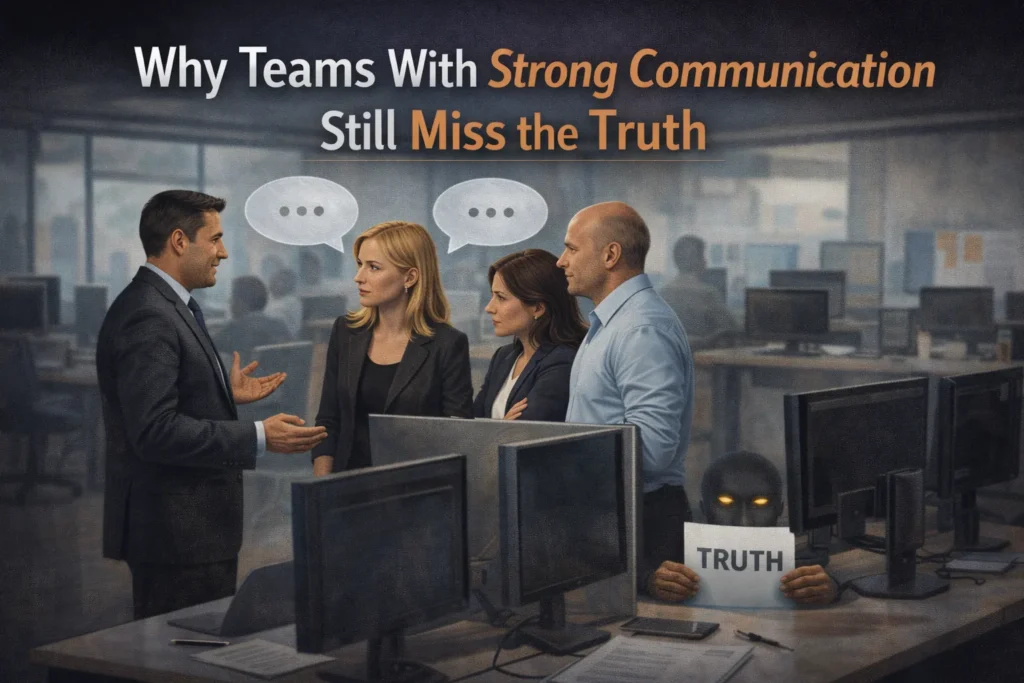
Strong communication is consistently listed as one of the foundations of high-performing teams. When you unpack what that actually means, it usually includes things like clarity, active listening, respect, psychological safety, feedback, alignment and trust. And somewhere on that list, often assumed rather than examined, sits honesty.
I think anyone would agree that intentional deception, hiding critical information, or outright lying is one of the fastest ways to break trust and damage communication.
But here’s where things get more complicated. What if the absence of truth isn’t malicious at all? What if no one is setting out to actively deceive anyone?
What if the truth simply isn’t being spoken for reasons that feel reasonable, protective or even well-intentioned.
This is where even teams with strong communication can still miss what really matters.
Truth and lies are rarely as black and white as many people like to think. The truth isn’t always the right thing in every moment and a lie is not always a bad thing. Sitting between those two extremes is a wide grey space and it’s the space most of us operate in every day.
Some years ago, I became curious about just how much space actually exists between truth and lies. I began mapping the many ways people step into that grey – not just the obvious deceptions, but the subtle, everyday behaviours that allow truth to be softened, delayed, filtered, or avoided altogether.
What started as a handful of observations quickly grew. I now have well over a hundred distinct shades of grey identified – patterns I’ve seen in leaders, teams, sales conversations, workplaces, relationships, and even in myself. Not to judge them, but to understand them. Because once you can see the grey, you stop being surprised by it.
This matters because most teams don’t miss the truth because people are dishonest. They miss it because people are navigating these grey spaces – often unconsciously.
A team member says ‘it’s fine’, when it’s really not.
A leader gives feedback that’s technically true, but carefully incomplete.
A concern is raised indirectly and softened, rather than expressed clearly.
A decision is supported publicly, but questioned or ridiculed privately.
None of this feels like lying. And yet, the full truth doesn’t surface.
One of the reasons this happens is that humans are wired for social survival. We’re constantly scanning for cues about safety, belonging and consequence. Before we speak honestly, we assess the room – who’s here, what’s at stake, how similar conversations have landed before and whether honesty will help or hurt us in that moment – or down the track.
Even teams that communicate will go through those same calculations. Strong communication skills don’t automatically override fear, hierarchy, pressure or uncertainty. They don’t remove the instinct to protect yourself, your reputation, or someone else’s feelings. So people choose a shade of grey that feels safest.
Another factor is that we overestimate our ability to read what’s really going on. When communication appears open and respectful, it’s easy to assume that important information will surface naturally. But behaviour, words and silence don’t always tell the same story.
A team can look aligned while carrying unspoken concerns
A meeting can feel productive while tension quietly builds underneath
A psychologically safe environment can still produce restraint when the stakes feel high
Strong communication creates the ‘potential’ for honesty, but it doesn’t guarantee it. That’s why communication alone is not enough.
In my work with leaders, sales teams and women in business, I often see teams that communicate well on the surface, yet still miss critical information until it’s too late. Not because people don’t care, but because the truth hasn’t been noticed, invited or interpreted accurately.
Trust doesn’t grow because everyone tells the whole truth all the time – that would be unrealistic and unsustainable. It grows because people become more conscious about which shades grey they’re choosing and why.
Strong communication matters. But without perceptiveness and without an understanding of how truth actually moves through people and teams, even strong communicators can still miss what matters most.
Strong communication gives teams a voice. Perceptive Communication determines whether the truth behind that voice is actually heard.